

Agentic AI vs Chatbots: Why Agents Win in Business
- groupAdmin
- event_available29-05-2026
- forumAI Automation
Most businesses have had this experience. A chatbot gets deployed for customer support. The team is excited. It handles basic FAQs, deflects a few tickets and then plateaus.
Customers still call for anything complex. The support team still follows up manually. Nothing is truly resolved. The chatbot answered questions but never actually did anything.
That frustration has a name in 2026: the chatbot ceiling.
The technology that breaks through it is agentic AI, systems that do not just respond to what you say, but take independent action to get the job done.
This is not a theoretical evolution. More than half of organisations are no longer treating AI as a limited pilot or interface layer. They are actively testing how autonomous systems execute work across departments. The question for businesses is no longer whether to use AI. It is whether they are using the right kind.
What a Chatbot Does and Where It Stops
A chatbot is a conversational software program that responds to user inputs through text or voice. It matches what you say to predefined flows or LLM generated answers pulled from a knowledge base. It is reactive by nature. It waits for you to ask something, retrieves an answer and stops there.
In 2026, the biggest limitation of the typical AI chatbot is not what it can read but what it cannot do. It lives in a read only world, answering questions without ever taking action on the underlying systems.
The pattern plays out the same way across industries. A customer asks to change their subscription. The chatbot explains the process. The customer then has to do it themselves or wait for a human. A patient asks a clinic bot to reschedule an appointment. It shows available slots. Someone still has to confirm the booking manually.
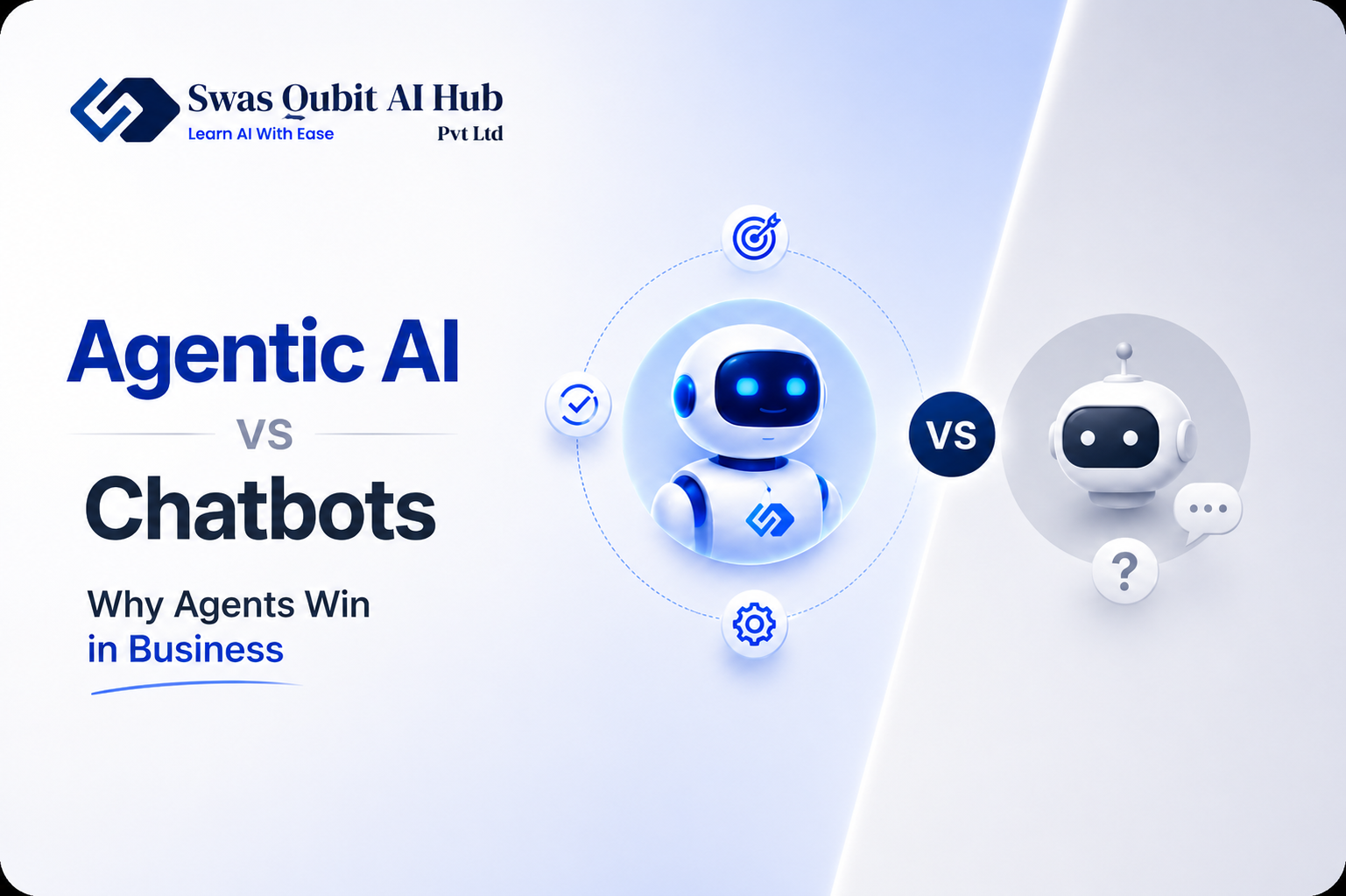
A chatbot resolves the conversation. An AI agent resolves the problem. The difference is whether the system can reason about context, act across your tools and close the loop without someone doing it manually.
That distinction - conversation versus resolution - is the entire argument for why businesses are moving beyond chatbots right now.
What Makes AI Agents Different
Agentic AI is not a smarter chatbot. It is a different category of system entirely.
While a traditional chatbot is reactive, waiting for you to ask a question before providing a pre-trained answer, agentic AI is proactive. It understands high level goals, reasons through constraints and dynamically adjusts its actions when conditions change.
The four capabilities that change what an agent can do:
- 1.Planning. Instead of matching a query to an answer, an agent breaks a goal into steps. Given "process this refund," it sequences every step automatically, verifying the purchase, checking eligibility, executing the refund, updating the CRM and notifying the customer.
- 2.Tool Use and System Integration. AI agents connect with software like CRMs, payment processors and scheduling systems to complete actions directly. A chatbot can answer a customer's question about a return policy. An AI agent can process the return request, generate a shipping label, update the inventory system and notify the customer when the refund is complete.
- 3.Memory Across Sessions. Most AI chatbots operate in a single session context. Once the chat window is closed, the conversation state is effectively gone and the customer has to explain their issue all over again. Agents retain context and improve from past interactions.
- 4.Autonomous Decision Making. AI agents identify tasks that need completion, determine optimal approaches and execute without waiting for explicit prompts at each decision point. They can detect an anomaly, initiate a fix and log the resolution before a human notices anything was wrong.
Want to learn how to build AI agents for real business workflows? At Swas Qubit AI Hub our AI Automation program covers agentic AI, workflow design, API integrations and multi agent systems, with hands-on projects throughout.
The Numbers Behind the Shift
The AI agents market is projected to exceed USD 10.9 billion in 2026, up from USD 7.6 billion in 2025, growing at over 45% annually.
Gartner projects that by the end of 2026, 40% of enterprise applications will include task specific AI agents. By 2028, agentic AI will enable 15% of day to day work decisions to be made autonomously.
93% of IT leaders intend to introduce autonomous agents within the next two years and nearly half have already done so.
Companies report average returns of 171% from agentic deployments, with US enterprises achieving 192% ROI, exceeding traditional automation returns by 3x.
These figures come from Gartner, IDC, McKinsey and Deloitte, organisations that measure what enterprises are actually building and spending.
Chatbots vs AI Agents: The Real Differences
- 1.Waiting vs Acting. A chatbot waits for a prompt. AI agents autonomously identify potential leads from CRM or external sources, qualify them based on set criteria, draft personalised outreach messages and follow up automatically.
- 2.Scripts vs Reasoning. Traditional chatbots follow rigid rule based scripts. Agentic systems use Large Language Models to reason through problems and create their own plans, allowing them to navigate ambiguity, handle incomplete inputs and recover when workflows break.
- 3.Siloed vs Connected. Chatbots often live in a single window. Agentic AI acts as an orchestrator, connecting across CRMs, ERPs and APIs to move data and take actions where they are needed.
- 4.Static vs Adaptive. Chatbots break when edge cases appear. Agents continuously adapt to new policies, exceptions and operating conditions, updating their behaviour in real time.
- 5.Deflection vs Resolution. Standard AI chatbots are often sold on deflection rates. But when you dig into the data, a large share of that deflection is actually abandonment. The user saw a partial answer, got frustrated and gave up. Agents are measured by task completion, not just conversation volume.
What Agents Are Delivering in the Real World
Klarna. Klarna's AI agent saved $60 million and handled the workload of 853 employees by Q3 2025, resolving customer disputes and processing queries end to end without manual handoffs for the majority of cases.
JPMorgan. JPMorgan runs 450+ agentic AI use cases in production daily, spanning fraud detection, document analysis and compliance workflows.
Salesforce. Salesforce cut $5 million in legal costs through contract automation using agentic systems that read contracts, flagged issues and routed approvals without a team of paralegals managing the process.
For high volume transactional tasks such as customer service, data entry and claims processing, AI agents improve cost reduction and speed. For knowledge work like research, analysis and content creation, ROI takes the form of productivity gains and error reduction.
Curious how to build these workflows yourself? Our 12 week AI Automation program at Swas Qubit AI Hub teaches you to design and deploy agentic systems using n8n, LangChain and real enterprise tools, project based throughout.
Where Businesses Are Deploying Agents Right Now
Customer Support. Where a chatbot answers the return policy question, an agent processes the return entirely. Teams using AI agents see 30 to 40% lower handling costs and can scale support without proportional headcount increases.
Sales. AI agents identify potential leads, qualify them, draft personalised outreach, follow up automatically, schedule meetings and log all interactions in the CRM, a full sales development workflow running without manual input.
IT Operations. An AI agent receives an IT help desk ticket, checks permissions and grants access if allowed or routes it for manager approval if needed. It then updates the ticket, notifies the employee and adds a resolution summary to the knowledge base.
Finance. Invoice exceptions, approval routing and compliance checks, high volume, rule heavy processes that agents handle faster and more accurately than manual teams.
Healthcare. AI applications in healthcare can generate up to $150 billion in annual savings by 2026 through agents handling patient onboarding, appointment management and prior authorisation workflows.
A Word on Agent Washing
Not everything marketed as an AI agent actually is one.
Gartner found that of the thousands of vendors calling their product an AI agent, only approximately 130 are verifiably agentic by any meaningful architectural standard.
Agent washing is when a vendor takes a retrieval tool, adds a conversational interface, calls it an agent and ships it. The product looks agentic in a demo but it cannot take an action, enforce a permission or close a loop without a human finishing the job.
Before committing to any platform, ask whether it can write back to your systems, not just read from them. Ask whether it initiates workflows or only responds to prompts. Ask whether it produces resolved outcomes, not just deflected conversations.
When Chatbots Are Still the Right Choice
This is not an argument that chatbots are obsolete. Many companies will adopt a hybrid approach, using chatbots for routine tasks and AI agents for complex, high value automation.
Chatbots remain effective for simple, high volume and highly repetitive interactions. Store hours, password resets, order status checks and basic FAQs. If the interaction ends after an answer, a chatbot is sufficient and often more cost efficient.
The strongest use cases for agents are repetitive, high volume, rules aware and measurable, support triage, IT operations, CRM hygiene, invoice exceptions and internal reporting are common starting points.
The decision point is straightforward. If the goal is answering, a chatbot is fine. If the goal is doing, you need an agent.
Why This Decision Matters Now
2026 is the year when AI adoption, model capability, enterprise integrations and pressure for measurable ROI are converging. Many organisations are ready to move from experiments to production agent workflows.
Once one department reduces a week-long process to a supervised same day workflow, other departments expect the same. The agentic enterprise becomes a pattern that spreads.
The businesses that build agentic workflows today will not just reduce costs. They will operate at a level that traditionally structured organisations simply cannot match at scale.
The shift from chatbots to agents is not a technology upgrade. It is a rethink of how work gets done. And it is already underway.
Build the skills that agentic AI actually demands. Swas Qubit AI Hub's program covers AI agents, workflow automation, RAG systems and real deployment, taught by practitioners, built around projects. Whether you are a fresher breaking into AI or a professional ready to upskill, your next step starts here.