Agentic AI vs Traditional Chatbots: Why Agents Win in Business
A technical comparison examining traditional chatbots, conversational language models, and tool-using agentic workflows, with an architectural evaluation of when to use each.
The Architectural Spectrum: From Rule-Based Bots to Autonomous Workflows
For over a decade, conversational interfaces have served as a common touchpoint for customer support and informational queries. However, the underlying architectures powering these interfaces vary significantly in capability, complexity, and operational scope.
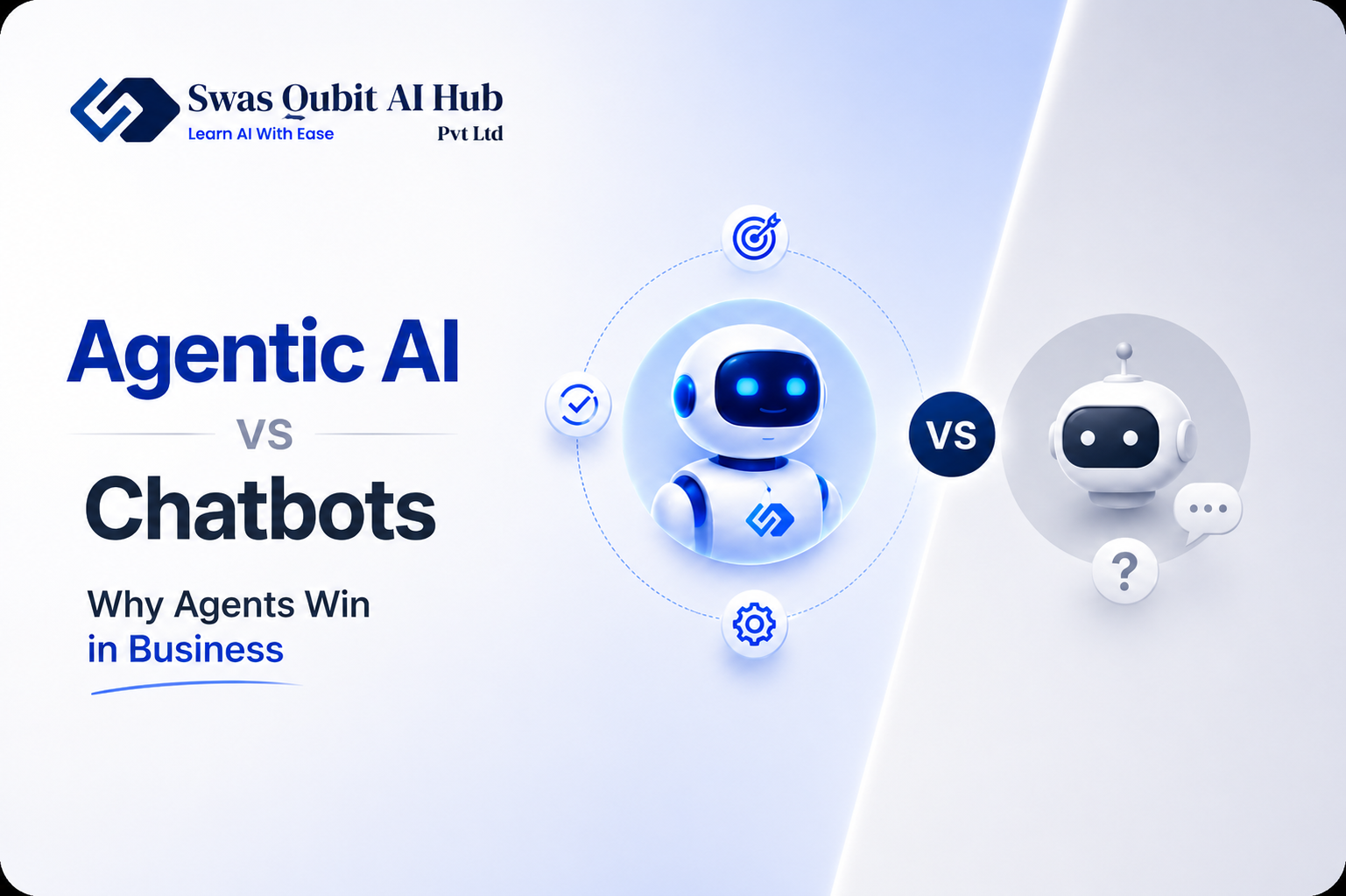
Traditional chatbots operate primarily on predefined decision trees or intent-classification models. While predictable and easy to constrain, they are fundamentally bounded: they cannot resolve requests that deviate from scripted pathways, nor can they dynamically plan multi-step actions across external systems.
Conversational LLMs improved linguistic flexibility, enabling natural language comprehension and fluent response generation. Yet, a standalone conversational model remains passive—it responds solely to user prompts without direct access to external environments, APIs, or database records.
Agentic AI introduces a distinct paradigm: iterative reasoning-and-action workflows (frequently referred to as ReAct-style architectures). In this model, an LLM functions as a reasoning engine within a software harness, empowered to plan steps, invoke tools, inspect tool outputs, and adjust course to achieve an assigned objective.
Core Mechanics of Tool-Using Agentic Workflows
An agentic architecture is not magic; it is a structured state machine paired with a language model capable of tool calling. The core operational loop follows a systematic sequence:
1. Planning: Given an objective, the model evaluates available tools and formulates an initial step.
2. Tool Execution: The host application executes the tool call (such as querying a SQL database, invoking a REST endpoint, or reading a file) on the agent's behalf.
3. Observation: The return value of the tool execution is fed back into the model's context.
4. Verification & Iteration: The model inspects the observation. If the result is incomplete or indicates an error, the model plans an alternative step; if the goal is met, it formats the final response.
- •Agentic workflows follow an iterative loop: Plan → Tool Execution → Observation → Verification.
- •Agents do not act autonomously in an unconstrained void; they interact through structured host applications and defined APIs.
Architectural Comparison: Traditional Chatbots vs. Agentic Systems
Selecting the appropriate architecture requires an objective assessment of system characteristics and project requirements:
Traditional Chatbot Characteristics
Primarily responds to direct user input within bounded parameters. Possesses limited action capability beyond pre-configured triggers. Operates with simpler control flow, lower latency, and deterministic constraints that are straightforward to monitor.
Agentic System Characteristics
Capable of executing multi-step workflows across external tools, databases, and APIs. Dynamically evaluates intermediate results and can self-correct when errors arise. However, introduces higher architectural complexity, execution latency, and requires rigorous evaluation and governance.
| Dimension | Traditional Chatbot | Agentic System |
|---|---|---|
| Execution Scope | Primarily responds to direct input within bounded parameters | Executes multi-step workflows across external tools, APIs, and databases |
| Action Capability | Limited action capability; predefined trigger trees | Dynamic tool invocation, system integration, and data querying |
| Control Flow | Simpler control flow; deterministic and straightforward to constrain | Iterative reasoning-and-action loops; dynamic execution pathways |
| Error Handling | Static fallback responses (e.g., “I did not understand”) | Inspects intermediate tool returns and adjusts subsequent steps |
| Governance & Complexity | Lower architectural complexity; lower evaluation overhead | Requires rigorous evaluation, human-in-the-loop checkpoints, and logging |
The Engineering Principle: Least Complexity First
While agentic AI unlocks powerful automation capabilities for complex business operations, it is not universally superior for every problem. Adding multi-step reasoning and dynamic tool execution introduces additional latency, cost, and potential points of failure.
Sound engineering practice adheres to a fundamental principle: Use the least complex architecture that reliably solves the business problem.
If a user query can be answered reliably with static FAQ documentation or a simple semantic search, deploying a multi-agent system is unnecessary overhead. Conversely, when a workflow demands multi-step coordination—such as checking inventory across multiple databases, validating user entitlement, issuing a payment refund via API, and generating a confirmation record—an agentic architecture delivers substantial efficiency gains.
- •Engineering principle: Use the least complex architecture that reliably solves the business problem.
- •Agentic systems are most valuable when workflows involve dynamic decision paths, external tool invocation, and intermediate verification.
Practical Business Workflows That Benefit from Agentic Systems
Organizations successfully deploy agentic architectures where manual multi-step operations create operational bottlenecks. Common practical applications include:
• Automated Document Triage & Processing: Ingesting invoices, cross-referencing ledger databases, verifying line items, and updating enterprise accounting platforms.
• Multi-Source Technical Research: Querying internal documentation repositories, synthesizing API changelogs, and generating formatted technical summaries.
• Operational Support & Remediation: Investigating system alerts, retrieving log traces via CLI tools, and compiling incident reports for engineering teams.
By grounding agentic workflows in verified tools and robust human-in-the-loop checkpoints, businesses achieve tangible productivity improvements while maintaining operational control.